Last week, I noticed that my practice is kinda surrounded by the concept of navigation as a controlled sytem that directs bodies towards intended directions.
I started to do more indept research about navigation and realised Navigation is always followed by movement. Through navigation, movement becomes a process across both time and space, what Adesola Akinleye describes as a form of “four-dimensional distance.” During Unit 2, I began investigating how graphic communication design could use movement to engage with heritage as an active process rather than a fixed historical subject.
I explored my personal family archive, the historical context surrounding it, and the recorded and unrecorded stories of Korean historical figures through different navigational systems: exhibitions, archives, books, captions, and moving image.
Rather than treating these as separate media, I became interested in synthesising them into one continuous movement condition, GPS, exhibition circulation, unfolding books, editing timelines, and audience movement all functioning as connected forms of navigation.
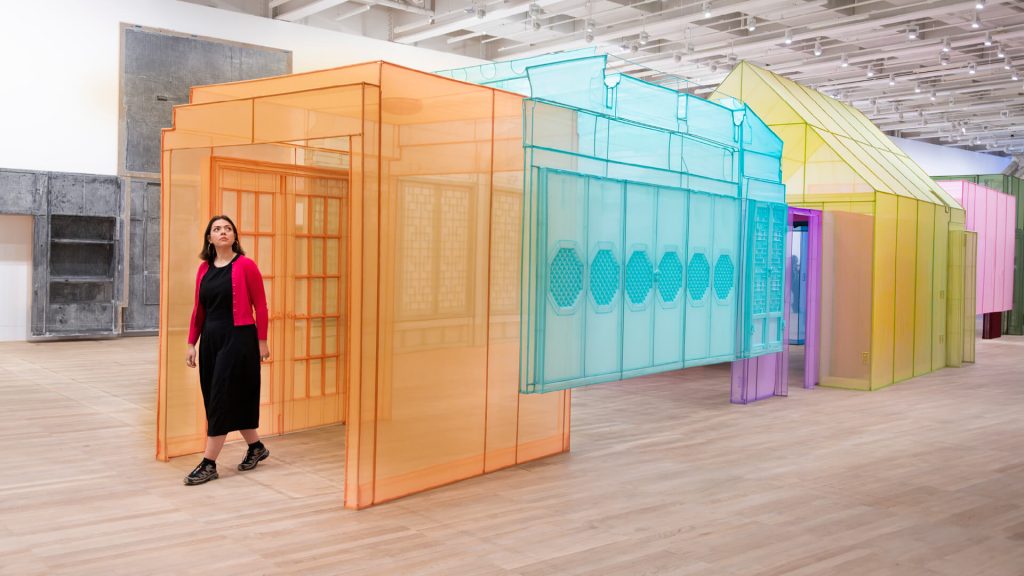
This approach was influenced by artists such as Do Ho Suh, whose work reconstructs home not through fixed representation, but through embodied navigation and spatial memory.
Also, based on the last week’s feedback on the physical and emotional experience for the audience to experience the distance of memory, absence, and historical fragmentation, I started to think about making physical space that explores how bodies are guided through institutional systems and how audiences might reclaim agency by rerouting themselves through alternative historical paths.
The structure of the video follows a movement progression:
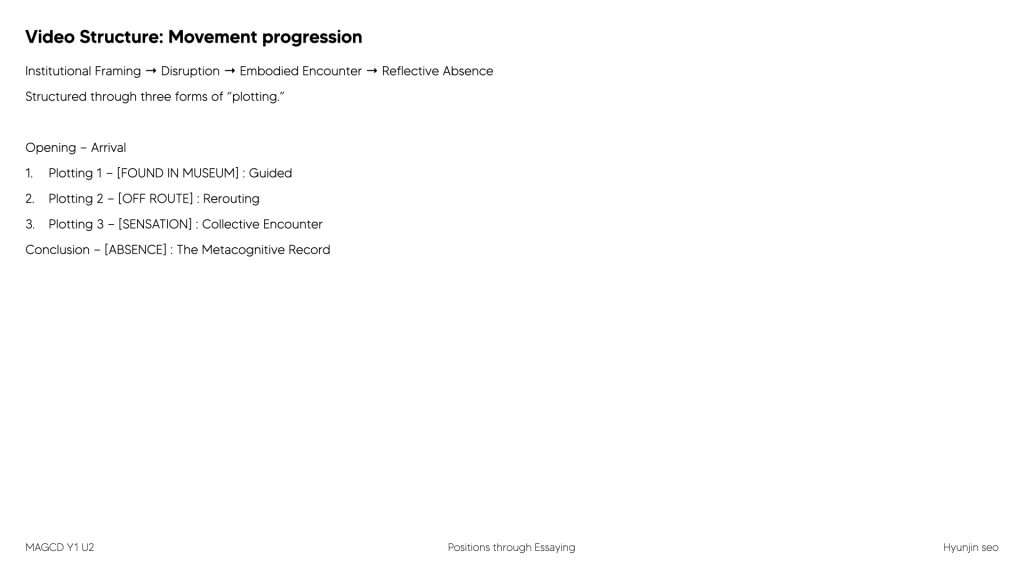
Rather than designing an informational experience, I wanted to design what I describe as an affective navigation condition, a system that changes the audience’s bodily and emotional relationship to history.
The project is structured through three forms of “plotting.” Rather than presenting a fixed narrative, plotting allows me to stage navigable relationships between fragments, voices, spaces, and movements. The focus is not simply what the audience sees, but what state they enter while moving through the work.
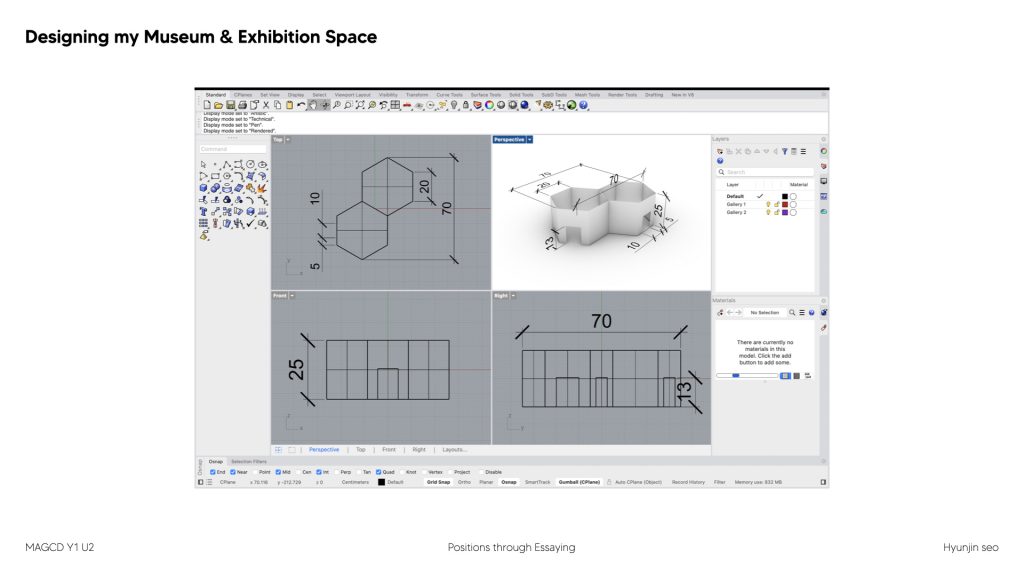
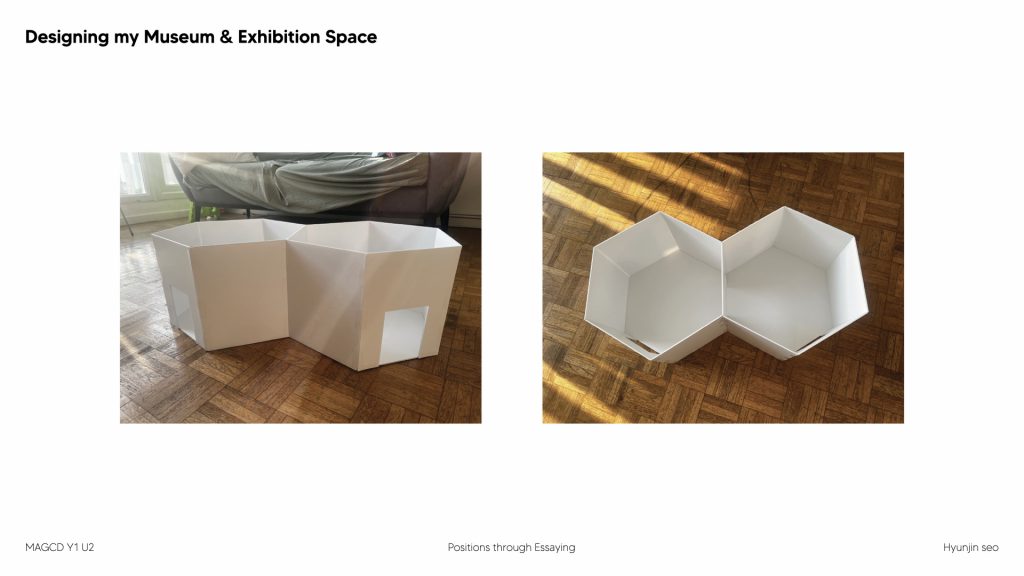
Then, I started to Design my museum and exhibition space.
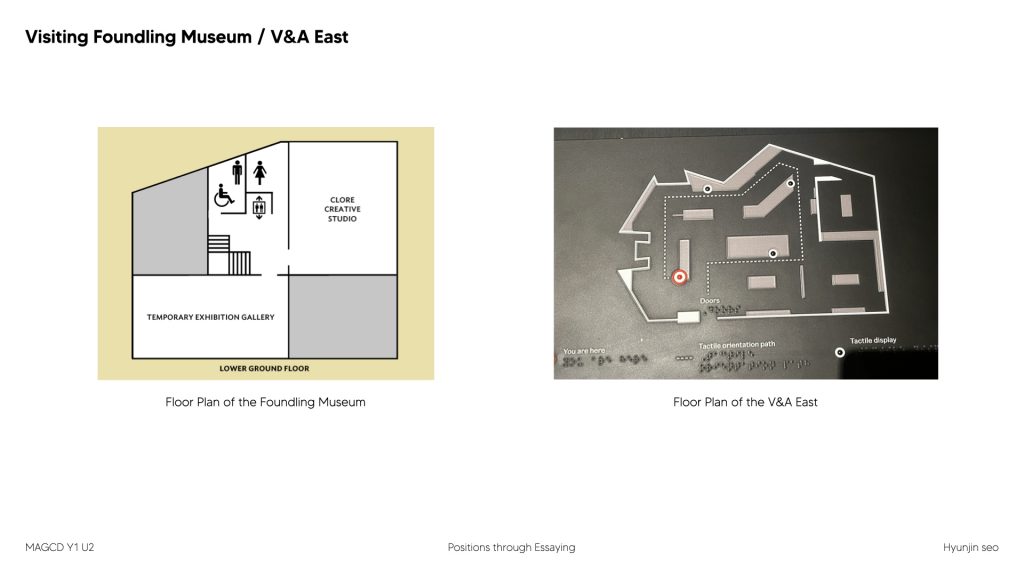
I Visited Foundling Museum, V&A East to Look at the their floor plan and started to develop mine.
I started to think about how my project began from Babel of library’s room. Using that as the base I started to develop some mockups. I used 3D Rhino to digitally sketch them and then cut out cardboards to build the museum space.
Refined Video Structure
Opening — Arrival
The video begins with a definition of navigation
Navigation search to the National Memorial of the Korean Provisional Government, the institutional site connected to my great-great-grandfather’s archive and the starting point of the project.
Initially I tried making this opening by navigating audience to the foundling museum.
However, when I talked to Aby, she suggested that the audience should be guided to somewhere incoherent to the subject I am dealing with, people of Korea. Almost like an actual essay briefly informing the audience what will happen in the main body. This made me to shift my Idea and redesign the storyline of the Opening.
Over these images, GPS navigation line (like a car satellite map) is superimposed, guiding a virtual arrow straight down a linear highway.
Exciting Korean show “Walking around the world” trade mark song plays.
Plotting 1 — [FOUND IN MUSEUM] : Guided
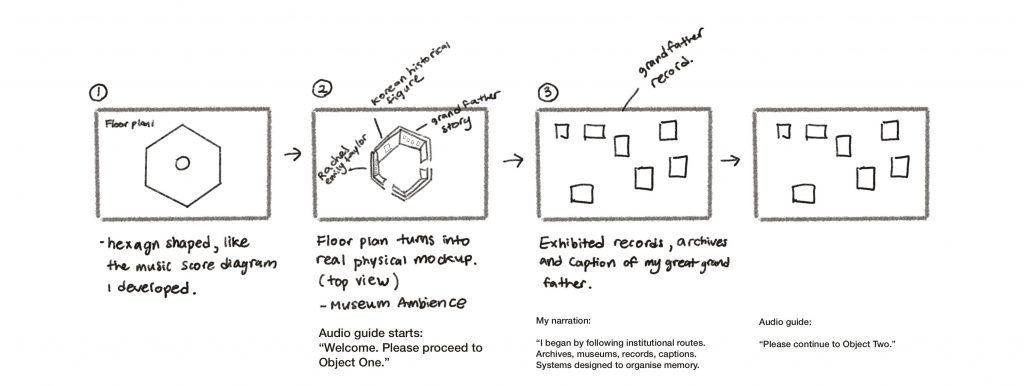
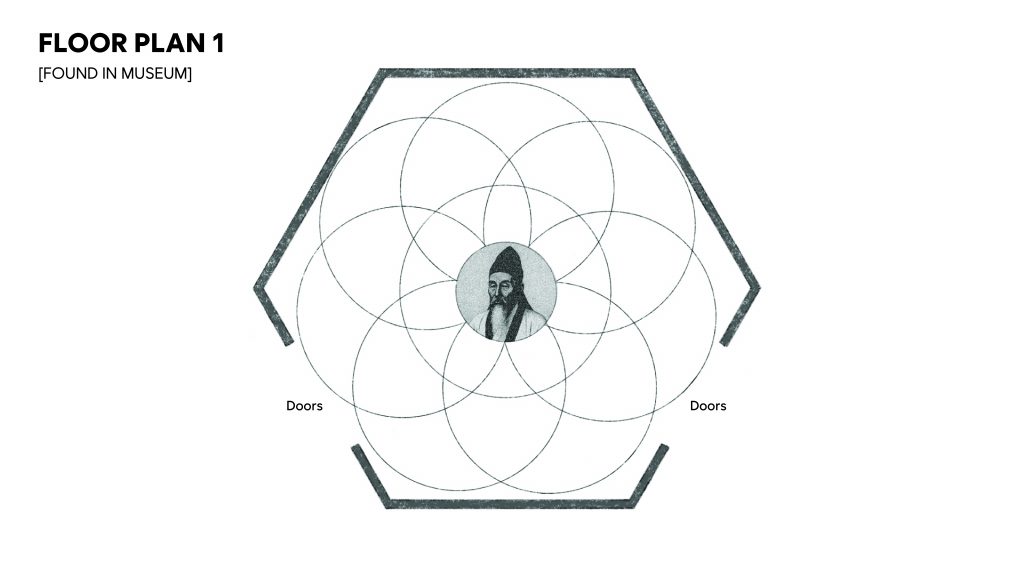
Floor Plan 1 Introduced.
The audience enters the museum through a guided route. Floor plans, archival fragments, captions, and audio guides organise the viewing experience into a coherent historical sequence.
Here, I reference Rachel Emily Taylor and her concept of “heritage as process.” Her work analysing erased voices within museum systems shifted my understanding of heritage away from fixed preservation and towards active reconstruction and audience participation.
This section investigates how museums, archives, and graphic systems flatten historical subjects into controlled narratives.
Plotting 2 — [OFF ROUTE] : Rerouting
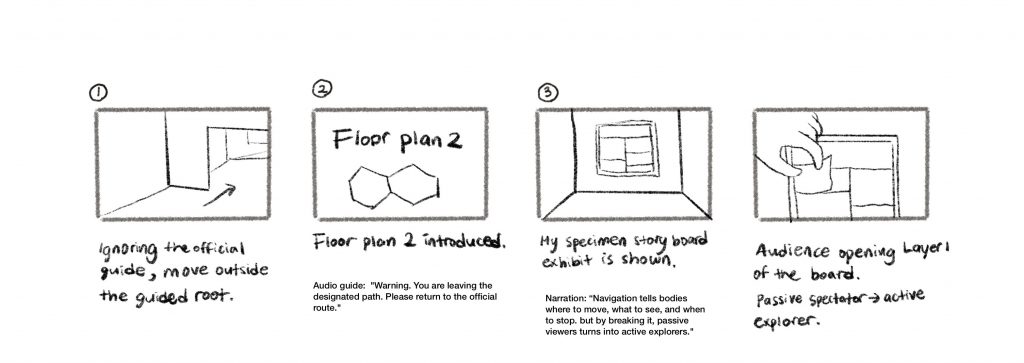
The audience begins ignoring the official audio guide and moves outside the designated exhibition path.
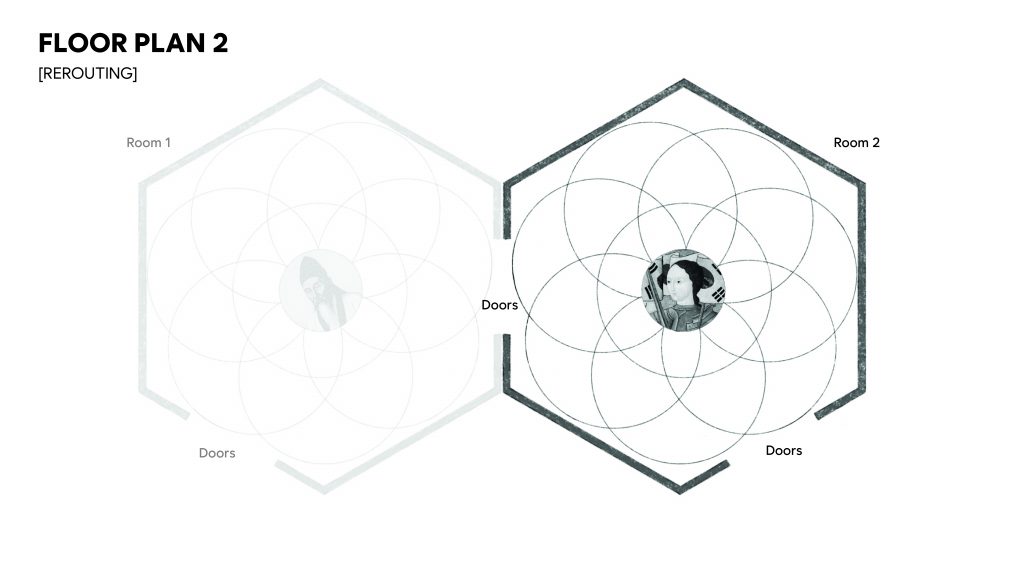
Floor Plan 2 Introduced.
As the guided route breaks down, hidden narratives emerge: untranslated grief, fragmented testimonies, erased historical figures, gravestones, state records, and unofficial archives. The exhibition becomes overloaded and unstable.
This moment transforms the audience from passive spectators into active participants constructing their own relationships between historical fragments. Navigation becomes an act of resistance.
Plotting 3 — [SENSATION] : Collective Encounter
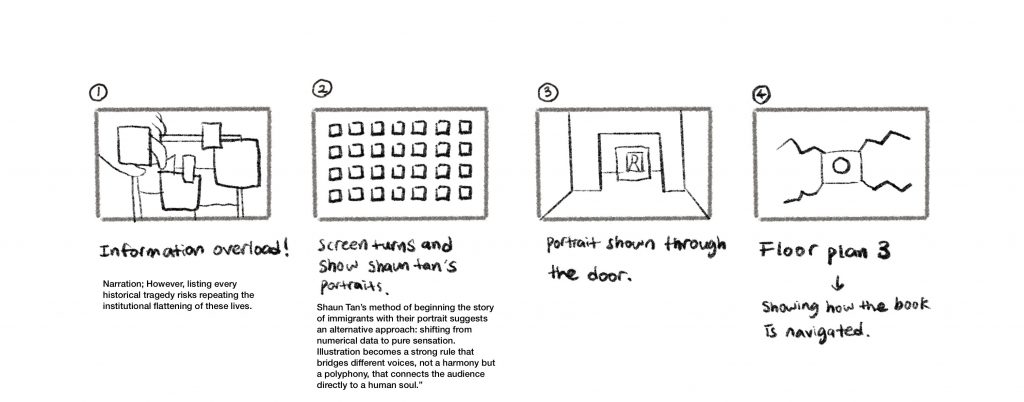
At this stage, I began questioning whether factual information alone could restore human dignity.
Influenced by Shaun Tan and The Arrival, I became interested in portraiture and illustration as a way to create sensory encounters rather than informational summaries. Illustration became a visual structure capable of holding fragmented voices together without flattening them into a single narrative. Through unfolding illustrated portraits, forgotten voices begin emerging beneath institutional surfaces.
Floor plan 3 introduced.
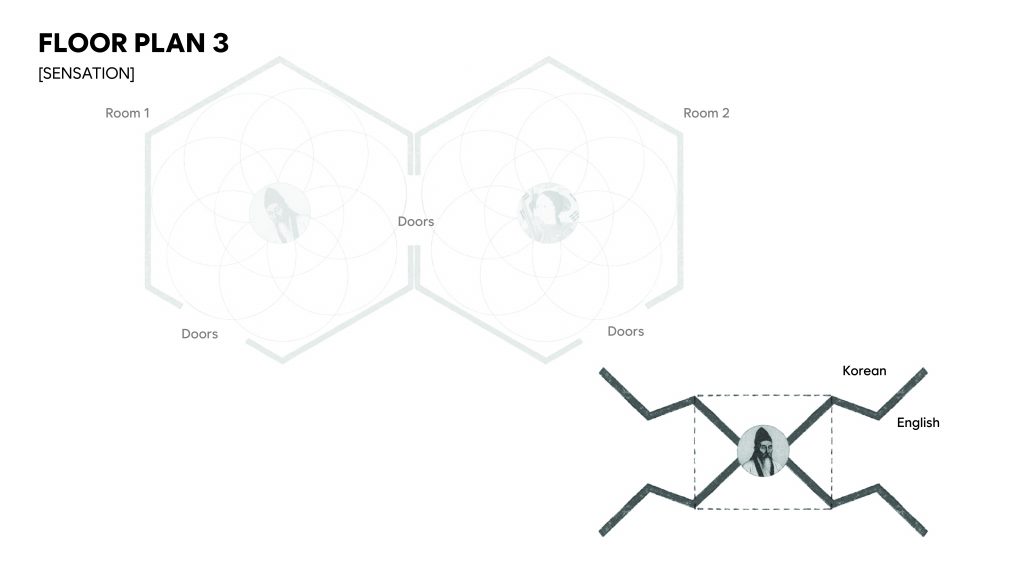
The accordion pocket-book becomes a navigation system itself: closed, it behaves like an institutional display; opened, hidden narratives unfold beneath it.
Conclusion — [ABSENCE] : The Metacognitive Record
The final section reveals the editing timeline of the video itself.
For the first time, the narration uses “I.”
The audience watches clips being rearranged, muted, deleted, and withheld. The editing process becomes visible rather than hidden.
This reflects my own positionality within the work. I realised that I am not a neutral storyteller documenting history objectively. I am actively selecting, organising, framing, and mediating historical fragments.
Institutions often hide their editing processes behind the appearance of neutrality. I wanted to expose mine.
The video ends with absence itself becoming the final record.
“What is not recorded is not absent. Its absence is the record.”
Leave a Reply