2 references drawn from the course reading list that situate your project in a broader discourse or conceptual domain.
- Tenen, D. (2017) ‘Literature down to a pixel’, in Plain Text: The Poetics of Computation. Stanford: Stanford University Press.
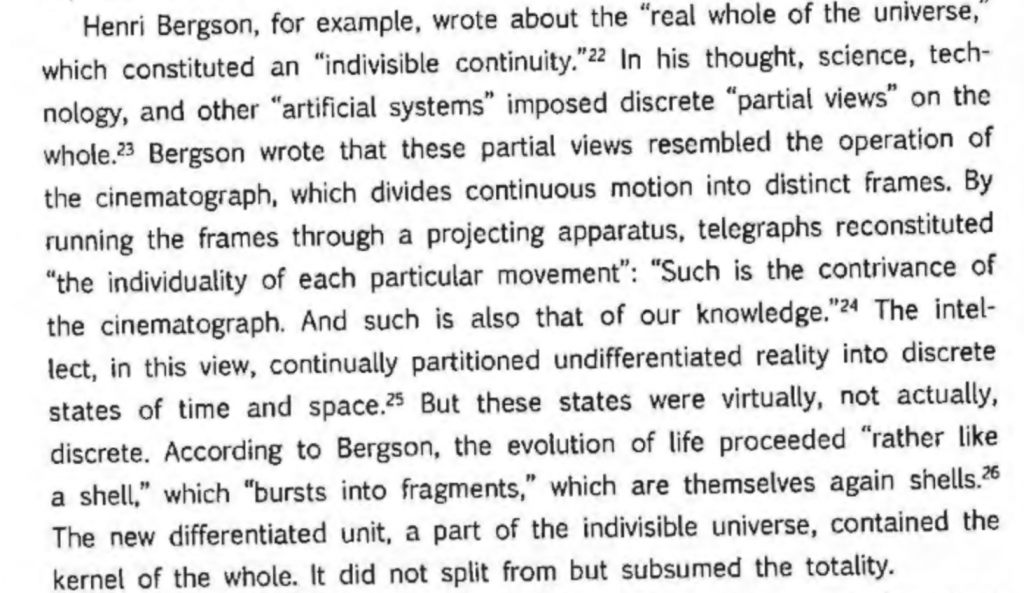
This text reframes my understanding of perception as an active process of reconstruction rather than passive reception. Drawing on Henri Bergson’s idea of the universe as an indivisible continuity, it suggests that what we perceive as discrete units are in fact partial views imposed onto a continuous whole.
In my Methods of Translating project, I fragmented my great-great-grandfather’s story—pausing and dividing a continuous narrative into temporal and spatial segments to make it legible for an audience. However, these fragments were never isolated; they remained deeply entangled with the larger whole. This reference helps me understand that such fragmentation is not simply a representational strategy, but a fundamental condition of perception itself.
Bergson’s rejection of the “flashlight model” of perception, where attention selectively illuminates reality, resonates strongly with my practice. Instead, perception operates through repetition, comparison, and accumulation. Building on this, my current Position through Iterating explores the structures of transformation itself, designing systems where narratives are not fixed but continuously formed through processes of breaking, layering, and recombining.
- Blauvelt, A., Maurer, L., Paulus, E., Puckey, J. and Wouters, R. (2013) Conditional Design Workbook. Amsterdam: Valiz.
“The designer no longer designs the final form, but designs the conditions in which forms can emerge.” (Blauvelt et al., 2013)
This text shifts my understanding of design from producing fixed outcomes to constructing open systems. It proposes a transition in authorship: from designer as tool user to designer as tool-maker, or even as a designer of conditions that enable others to act. Rather than determining form or meaning, design operates through relationships, feedback, and distributed agency.
This directly informs my current Positions through Iterating project, where I move away from producing singular narratives toward building systems that allow multiple stories to coexist. By introducing a “music theory tree” structure, I translate musical logic into a narrative system: major notes become central figures, modes act as perspectives, and chords represent the collision of viewpoints. This framework resists the flattening of complex histories into a single, linear account.
Instead of presenting a resolved interpretation, I construct a platform in which narratives are continuously generated, layered, and recombined. In this sense, my role shifts from authoring meaning to designing the conditions through which meaning can emerge.
1 reference that is specifically related to your project in its topic (theme or subject matter)
- Pachinko (2022) Created by Soo Hugh. Available at: Apple TV+.
“History has failed us, but no matter.” (Pachinko, 2022)
Pachinko situates my project within a broader discourse of diasporic identity, generational memory, and survival under historical violence. The series traces the lives of Koreans living under and after Japanese colonial rule, foregrounding how displacement, family ties, and historical conditions shape personal identity across generations. Its narrative resonates closely with my own exploration of my great-great-grandfather’s story, particularly in its attention to inherited trauma, resilience, and the emotional complexity of belonging and estrangement.
However, what distinguishes my practice from Pachinko is its narrative structure. While the series powerfully delivers emotional depth through a cohesive, linear storyline centred on Sunja and her family, it ultimately consolidates multiple experiences into a singular narrative arc. This produces immersion, but also limits the coexistence of conflicting perspectives.
In contrast, my work seeks to resist this narrative convergence by constructing systems in which multiple voices, contradictions, and temporalities can exist simultaneously. Rather than telling one story, I design conditions where stories remain open, fragmented, and relational.
1 reference that is specifically related to your project in its medium or method
- The Library of Babel (1941) by Jorge Luis Borges.
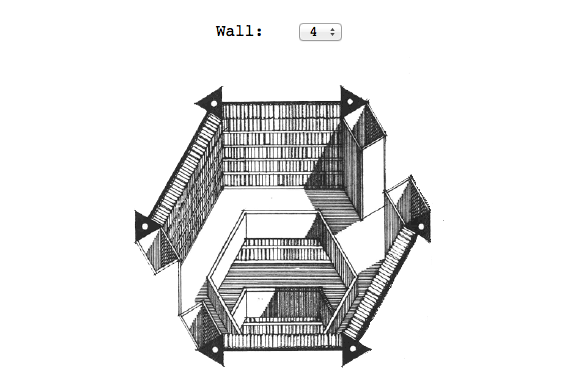
“The universe (which others call the Library) is composed of an indefinite, perhaps infinite number of hexagonal galleries.” (Borges, 1941)
In The Library of Babel, Jorge Luis Borges constructs a universe not from matter, but from books, endless hexagonal rooms filled with every possible combination of letters. Meaning does not reside in any single text, but emerges through wandering, misreading, and accidental encounters. Truth is not given; it is assembled.
This logic closely informs my Positions through Iterating. If Borges builds his universe from books, mine is built from perspectives. Each voice, across nations, generations, and positions, functions like a volume on a shelf, partial and situated. Together, they construct an unstable but expansive understanding of a single figure: the independence activist.
Unlike linear narratives that guide the viewer toward one interpretation, my system invites navigation. Meanings shift depending on where you stand, how far you move, and which voices you encounter. Like Borges’ library, it contains both truth and fabrication—archives and imagined reconstructions, intentionally entangled. I am not telling a story; I am building a space in which stories collide, echo, and continuously reconfigure.
1 reference that demonstrates a critical position in context of your specific topic, medium, or method
- Templo (c. 2021) Interconnected Disaster Risks Visual Identity. Collaboration with United Nations.
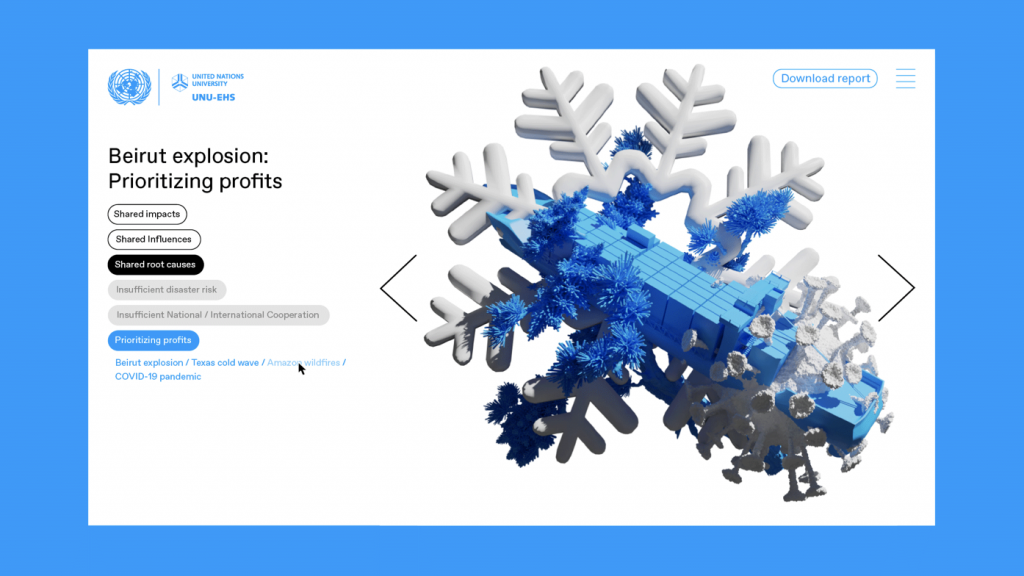
The collaboration between Templo and the United Nations offers a critical model for visualising complexity without reducing it. Rather than presenting disaster events as isolated incidents, the project maps them as interconnected systems, revealing shared underlying causes through spatial “collisions” of 3D forms. This approach resists the simplification of global crises into singular narratives and instead foregrounds relational structures and systemic responsibility.
This is directly relevant to my practice, where I question how narratives become flattened through selection and representation. While traditional storytelling often isolates events into linear, digestible forms, Templo’s work demonstrates how meaning can emerge through accumulation, overlap, and interaction. Their use of topology as a visual language aligns with my interest in designing systems where multiple stories coexist and inform one another.
In my Positions through Iterating, I similarly construct frameworks, such as the music theory tree, where perspectives intersect and reshape each other. Rather than guiding the viewer toward a single conclusion, I aim to expose the underlying structures that connect seemingly separate narratives.
1 wild card reference (identify another type of relationship, or re-use any of the above prompts)
- Problems of Dostoevsky’s Poetics (1929) by Mikhail Bakhtin.
“A plurality of independent and unmerged voices and consciousnesses.” (Bakhtin, 1929)
Mikhail Bakhtin’s concept of polyphony provides a critical lens through which I understand my shift away from singular authorship. In a polyphonic structure, multiple voices coexist without being subordinated to a central, authoritative perspective. Each voice retains its autonomy, creating a space where meaning emerges through dialogue, tension, and coexistence rather than resolution.
This directly informs my Positions through Iterating, where I resist constructing a unified narrative and instead design systems that allow perspectives to remain distinct yet interconnected. Drawing from musical polyphony, I think of narratives not as linear progressions but as simultaneous layers, voices that overlap, diverge, and occasionally collide. In this structure, no single viewpoint is privileged or resolved into a final truth.
Rather than acting as an omniscient author, I position myself as a facilitator of relations, enabling interactions between voices across time, geography, and identity. My work, therefore, becomes less about telling a story and more about sustaining a condition in which multiple stories can speak, coexist, and continuously reshape one another.
A short statement (100–200 words) that articulates your line of enquiry. What questions are you exploring in this project, and how are you exploring them? Be as focused and specific as possible. (Tip: Don’t try to write this during the first week. Wait until your iterations have developed meaningfully.)
My project begins with a critical reflection on my practice as a structural translator rather than an image-maker. While I analyse topics to uncover underlying systems and translate them through visual and empathetic tools, I noticed a recurring contradiction: although my process engages complexity, the final outcomes inevitably flatten it into readable representations.
This led me to question flattening not as a byproduct, but as a condition of representation itself. What is lost when we make something legible? What becomes visible but less felt? And crucially, can flattening be resisted, delayed, or exposed rather than avoided?
Using the auditory map from Methods of Translating as a testing ground, I examine my own acts of translation to observe how flattening occurs and how it might be undone. Through iteration, I discovered that non-flat narratives are not linear or singular, but accumulate, overlap, and remain unresolved.
This shifted my enquiry toward system-building. Drawing on musical structures, rhythm, repetition, layering, and polyphony, I ask: how can multiple voices be experienced simultaneously without collapsing into one? My aim is not to eliminate flattening, but to design a navigable system in which it is delayed, revealed, and actively resisted.
Leave a Reply