What I realised during Positions Through Iterating was that I enjoy assembling fragmented stories to construct new forms of narrative.
At first, I thought the system itself was becoming the core of my practice. I built structures, rules, and iterative frameworks to hold multiple perspectives together.
But eventually I realised something important: the system is not the centre of my practice. I am interested in systems as tools for storytelling, as conditions that allow hidden or flattened stories to emerge.
As I researched further, I realised that what I thought was a family story was actually something larger. It was about heritage, and specifically, about how heritage is made.
I looked at references like:
- Rachel Emily Taylor — Heritage As Process: Constructing The Historical Child’s Voice Through Art Practice.
Based at the Foundling Museum, the project critiques how children’s histories are often told through adult voices. It identifies a key issue: children are largely voiceless in museum narratives, as history is preserved by adults for them. Using art practice as a method, Taylor reconstructs the child’s voice through workshops involving role-play, empathy, and making. The outcomes are tested through curated artworks within the museum and explores how museums can move from singular, institutional narratives to multiple, coexisting voices, and proposes art as a tool to reframe historical voice and agency. - Yeni Kim — Tamnarok: The Record of Tamna.
A practice-based research project exploring illustration as a tool to manifest intangible cultural heritage, focused on endangered cultural forms: Haenyeo 해녀 and the Jeju language 제주방언. She identifies a generational gap, cultural knowledge is fading due to disengagement of younger generations, and positions illustration as a method to examine lived experience and activate cultural understanding. Her methods include drawing during interviews to visualise verbal narratives, workshops with children to deepen engagement, and translating outcomes into a picture book using the Jeju language. The work demonstrates illustration as a generative, not just representational, tool, sustaining culture as lived and living, not fixed or archived. - Do Ho Suh — Walk the House.
Suh explores home, identity, and memory through installations, drawings, and video, rooted in the Hanok, the Korean traditional house, a structure that can be disassembled and relocated, symbolising mobility and migration. His ongoing Bridge Project investigates the idea of a “perfect home” intersecting with social, political, and ecological realities. Themes of migration, displacement, and memory extend beyond national boundaries, using personal experience to trigger collective resonance. The work demonstrates how private stories can become shared experiences, and actively encourages audience participation through memory recall.
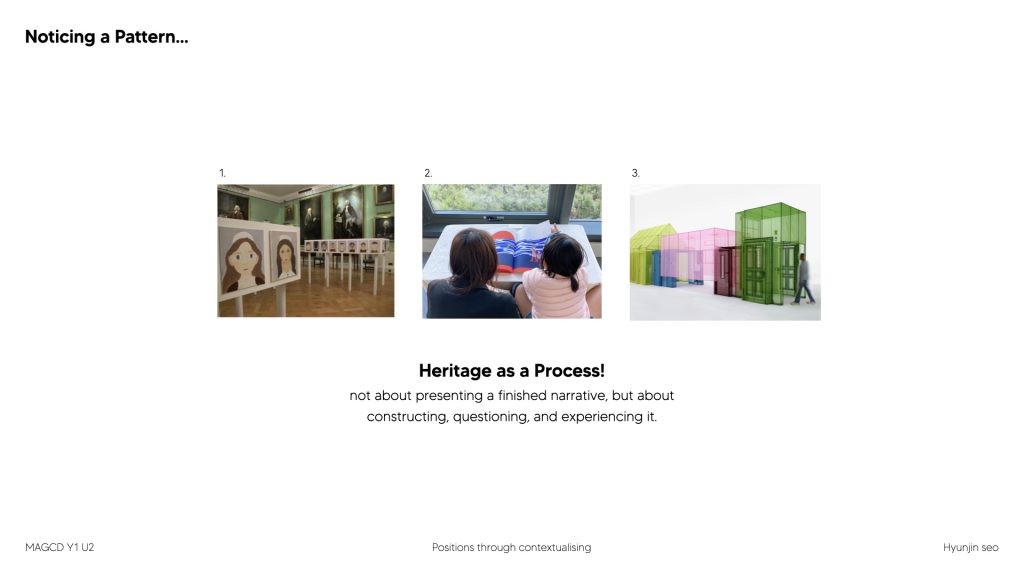
All of them approached heritage not as a fixed subject, but as a process, through participation, making, and engagement. Their work wasn’t about presenting a finished narrative. It was about constructing, questioning, and experiencing. And I realised I was doing the same thing. But with difference. They worked within institutional frameworks. I wanted to break them.
This made me realise that my work, which I had previously thought of as simply a “family story,” is in fact dealing with heritage, specifically, heritage as a process. This explains the tension I had been experiencing between emotion and logic, between storytelling and system. Heritage itself exists within this tension. It is shaped by preservation and control, but also by memory, emotion, and interpretation.
At first, I wanted to explore this through DNA as a metaphor for inherited memory and transmission. But I realised that I was already dealing with histories that were incredibly dense and difficult. Adding another scientific framework risked distancing the work even further. So instead, I decided to empty my head and return to something more direct: my own heritage, my family history, and the structures surrounding it.
Every document left behind by independence activists, including my great-great-grandfather, was written by someone else. Korean, Japanese, Chinese, descendants. The activists’ own voices are absent. What remains are fragments: pieces of paper, in different languages, shaped by different political conditions.
And this is not just a problem of the past. After liberation, the Korean state continued to choose which stories to keep and which to erase.
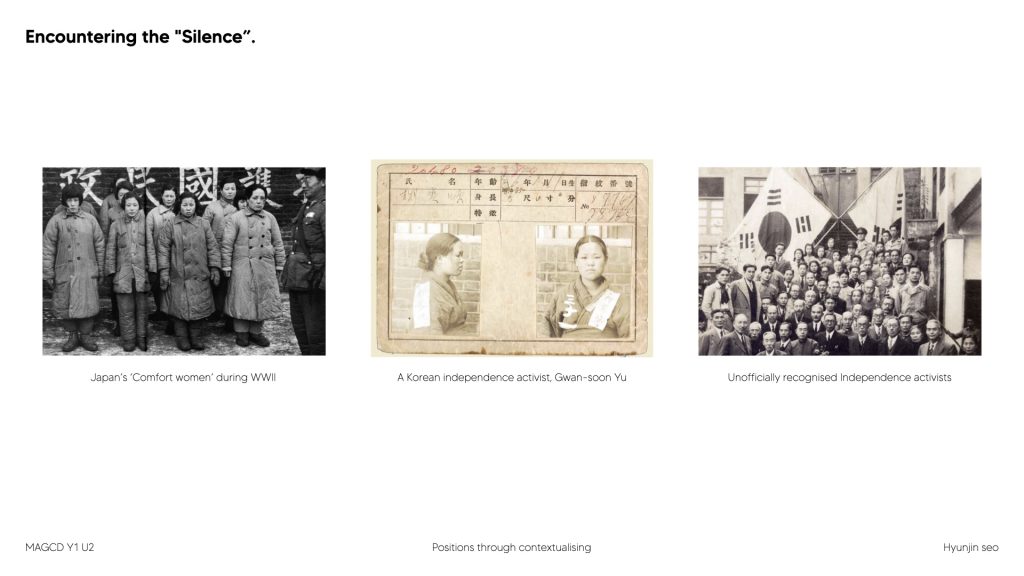
Socialist activists were excluded due to Cold War politics. Women’s contributions were recorded only as supporting their husbands. Survivors like the comfort women grandmothers were officially commemorated — and simultaneously controlled. The archive was never neutral. It was always already a form of power.
This led me to my critical enquiry:
How can graphic communication design resist institutional control of heritage by turning archival silence into an act of reconstruction?
And my positionality:
As both a granddaughter descended from the subject and a graphic designer assembling fragmented archives, I occupy a dual position, simultaneously inside the inheritance and outside the historical record, making my act of reconstruction neither neutral nor complete.
Responding Prompt 3: Translate the reference into a new medium in order to introduce it into a different (but specific) context. Consider various methods of translation, such as: copying, parodying, relaying, interjecting, extrapolating, hybridizing, paraphrasing, etc.
For Prompt 3, I translated Rachel Emily Taylor’s methodology into a new medium and a new context.
Rachel’s starting point was the museum caption. She worked within the institution, restoring unheard voices through workshops, then re-curating them back into the museum space. She resisted from inside the frame. I wanted to break the frame itself.
Rachel uses the Scottish definition of curating — to look after.
My version of curating is also to look after — but in the sense of to look after what has been left behind, to search for, uncover, and reveal. To find what the institution chose not to keep.
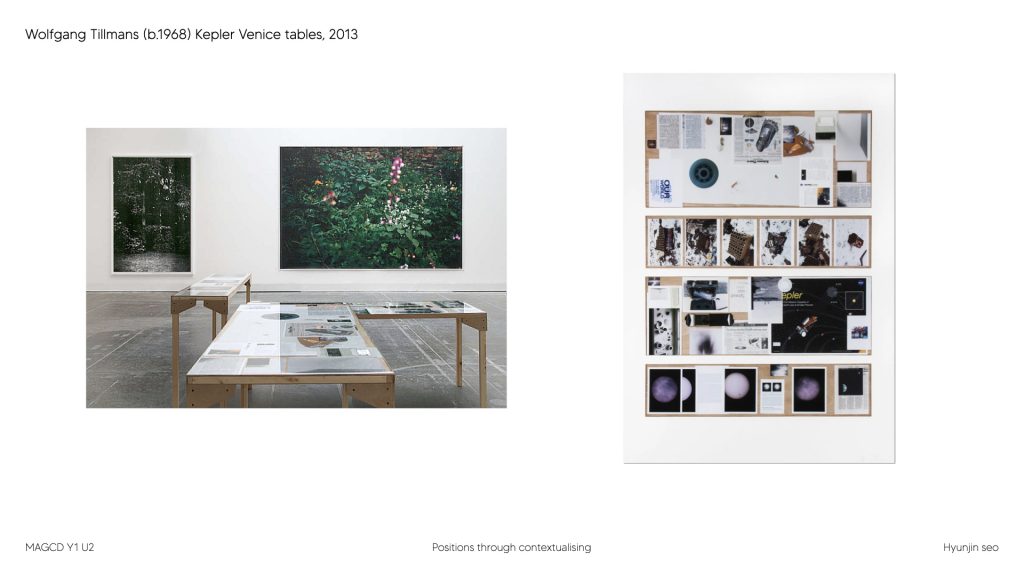
Looking at the venice table by wolfman gang’s venice table I started to think about how I can make the audience to look after what has been left behind, to search for, uncover, and reveal. To find what the institution chose not to keep.
Working at a museum, I photographed one of the display cases, a Victorian specimen case titled “FORE LIMB OR WING.”
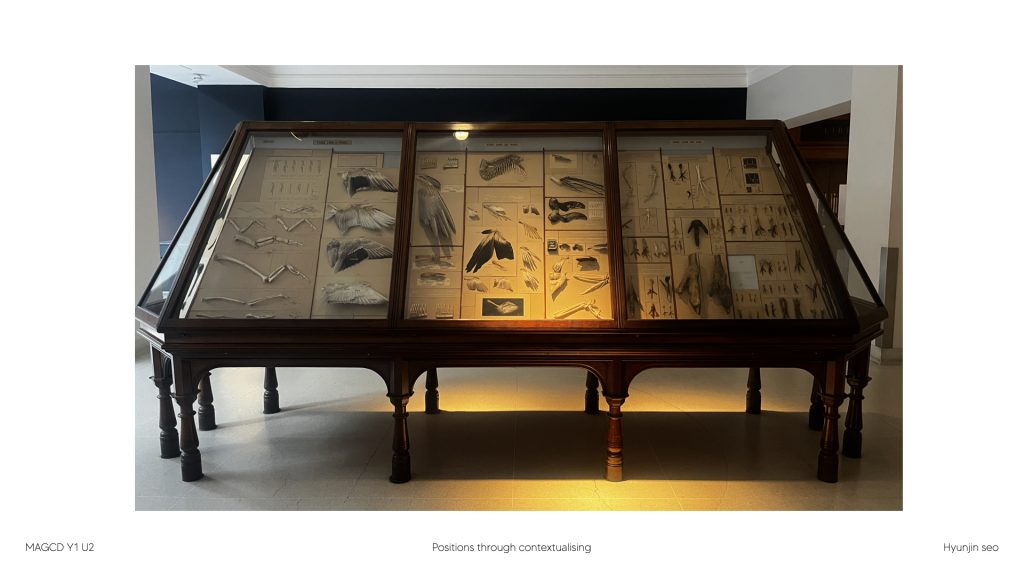
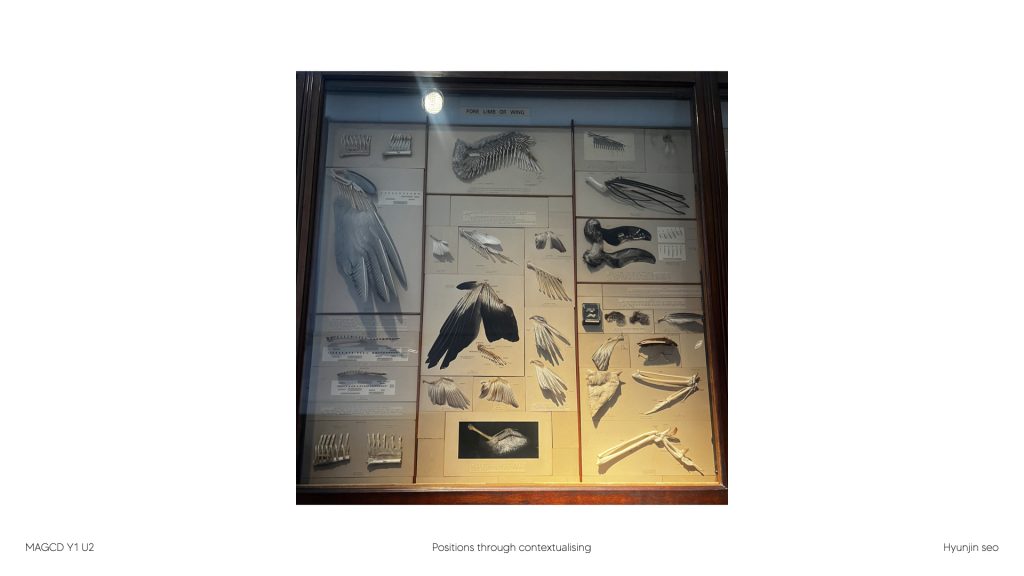
Objects pinned down, labelled, arranged behind glass. A life reduced to a caption.
This image became the starting point for my method: folding.
I wanted to reconstruct the flattened heritage into a living narrative by transforming the static archival system into a dynamic, ‘folding’ process that synthesises fragmented data into a functional organic whole.
I started to explore this idea with a single sheet of paper, folded, cut, and layered, that functions as both a display case and an archive.
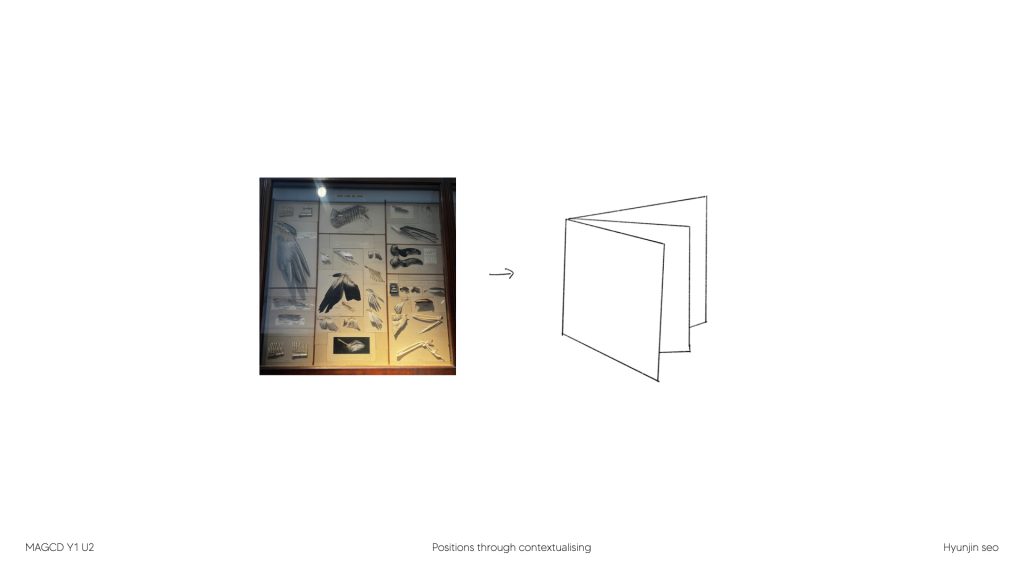
On the surface, it looks exactly like an official exhibition. Authoritative. Complete. The kind of display a national museum would be proud of. But the folding structure means it can be opened. And the act of opening is itself a critical gesture. The audience doesn’t passively view, they physically break the institutional surface to reach what lies beneath. Each layer has a title that shifts as you go deeper.
Unfolding each Layers
Layer 1: Those Who Are Remembered — the official surface. Recognised figures, formal captions, state-approved narratives.
Layer 2: Those Who Are Not Remembered — the same people, but the cracks begin to show. The same figures, the same spaces — but what the institution chose not to say.
Layer 3: Those Who Refused to Be Remembered — critical fabulation. Voices that were never recorded, written in the absence of a record. Based on Saidiya Hartman’s concept: filling the gaps with imagination, but never hiding that it is imagination.
The Stories
I started to do some research on Korean historical figures, who were represented by Korean Institution, and explored how they were presented. Then, I started to look at their stories that were not selected by the institution to be presented.
I then tested this the folding structure across four stories I found.
The first is the comfort women grandmothers and the House of Sharing. On the surface: a sanctuary, a symbol of remembrance, 155 Statues of Peace installed worldwide. Underneath: of 8.8 billion won raised in donations, only 200 million reached the survivors. A devout Catholic grandmother was given a Buddhist funeral against her wishes. Her belongings were left in a car park, covered in plastic, in the rain. The story the institution told and the story the grandmothers lived were not the same story.
The second is Park Cha-jeong. On the surface: a recognised independence activist, awarded the Order of Merit in 1995. Underneath: her gravestone does not bear her name as an activist. It reads, Wife of General Yaksan Kim Won-bong.Fifty years of suppression because her husband defected to the North. The critical fabulation: a revised gravestone. The one that should exist, but doesn’t.
The third is Yu Gwan-sun. On the surface: the most perfectly flattened figure in Korean history. One photograph. A few lines. A complete heroic narrative. Underneath: she was virtually unknown before liberation. She was selected for the textbook because someone was looking for a Korean Joan of Arc. Her image was used by the Park Chung-hee regime to justify nationalist unity. On the day of her protest, there were 3,000 people at Aunae Marketplace. One name was recorded. The rest became a crowd.
Lastly, Its all the activist who refused to be represented as an ‘Official Independence Activist’ as they felt like they were being used for political purposes.
Here is the final outcome:
Feedbacks
Positive
- Critical fabulation’s visual quality is really strong.
- Cosidering my position within the practice is also very strong. evolving nicely and differently.
Negative
- Maybe having actual physical object? documents that folds out?
- Consider having both Korean and English. Two audience have completely different understanding of these subject. Maybe having different captions?
- Information density & richness is a lot, but maybe there is too much story? consider how I can use graphic communication design as a tool to making it interesting
- Something about Museum display makes it more easy for audience to embrace all the information on the spot and all of them are the ‘Wings’.
- Materiality super important. How I might present this to people, visual language. How do i want it to feel and come across.
- Consider adapting Korean typeface.
Leave a Reply