To begin this project, I started by evaluating my previous projects from unit 1, using the provided van diagram and examine my practice into three big categories: Topics, Methods, and Media.
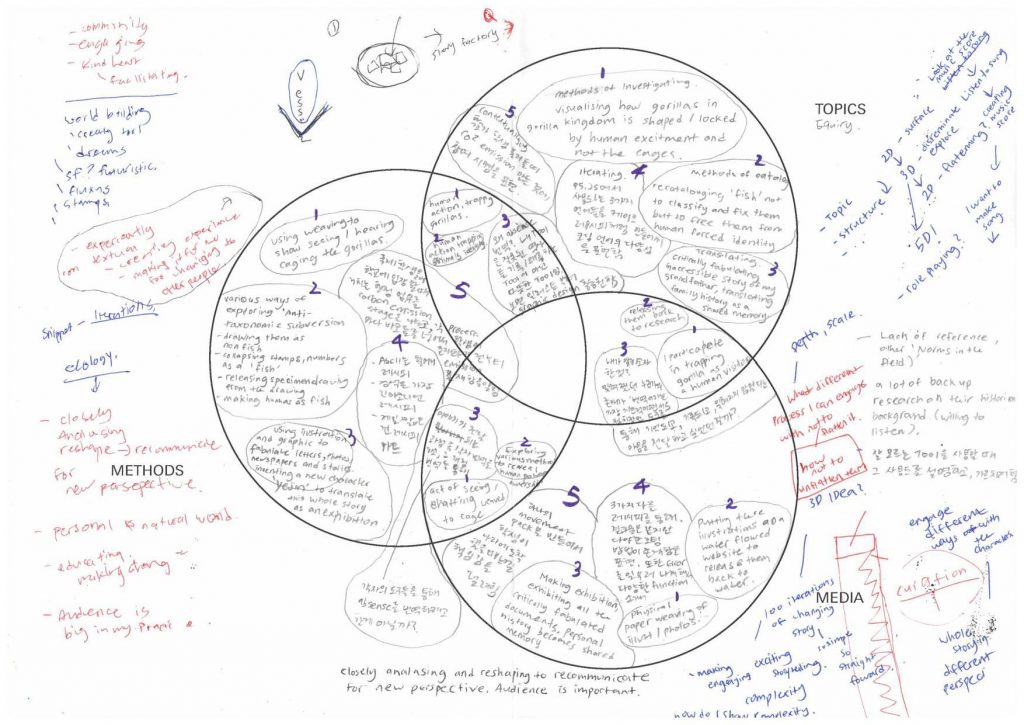
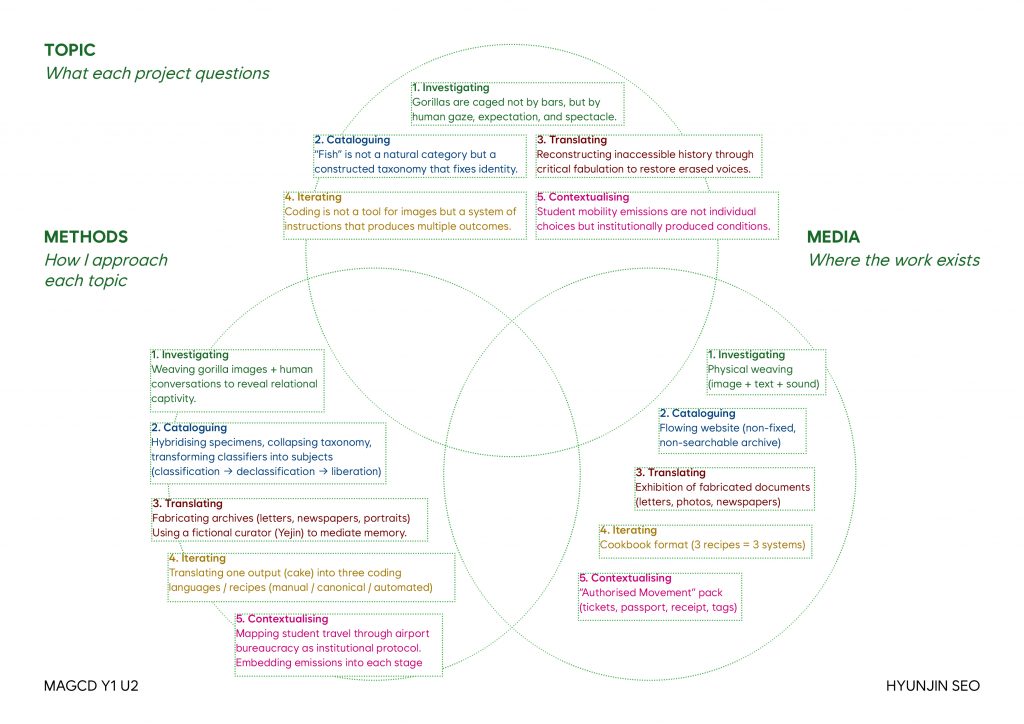
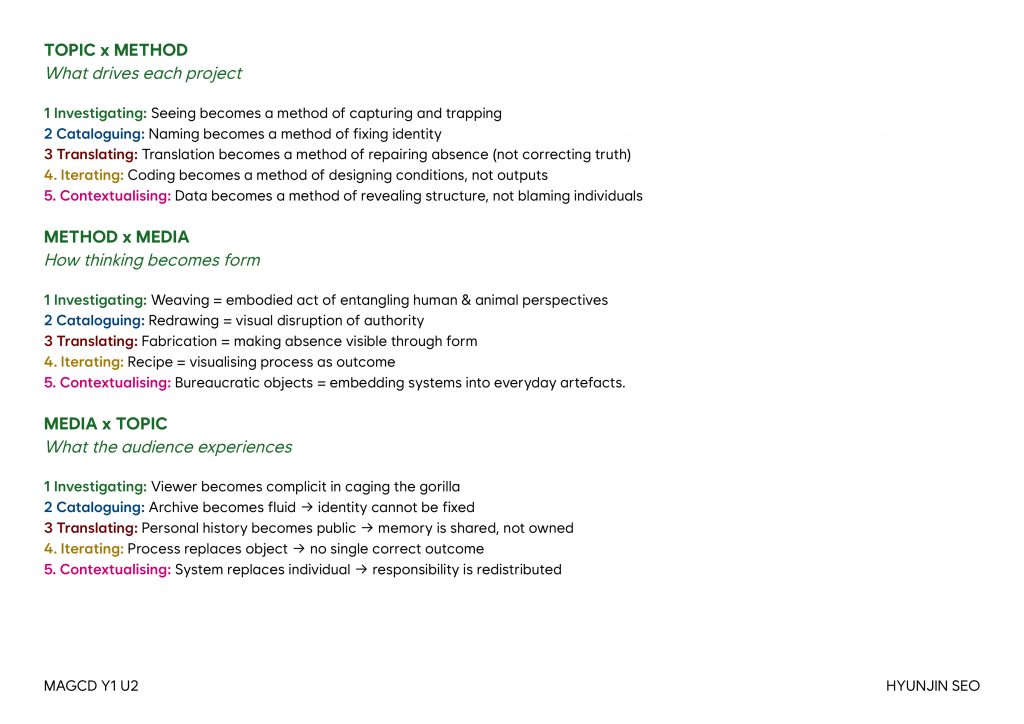
Through this process, I noticed interestings overlaps in my practices.
I am not an image maker, but a structural translator
→ My work does not represent visible subjects,
→ It reveals hidden systems of power and structure
- Gorilla Kingdom → Not about animal rights but spectatorship structure.
- ‘Fish’ → Not about living matters but about taxonoical power structure.
- My great great grandfather → Not about personal story but about historical record power structure.
- Cake coding → Not about the outcome but about the production system structure.
- Movement pack → Not about the action but about the institutional mobility structure.
→ Not visualising what is visible, but revealing what is hidden behind how it is framed.
Empathy as a tool
My tool, graphic design, is not a detached instrument of observation, but a mediator that comforts and preserves the memories of family histories and marginalised beings. I defined translation as both a deeply personal and inherently political act.
Reconfiguring responsibility
→ My work does not deliver information
→ It repositions responsibility
- Animal is not trapped → we built the system
- Fish is not real → we named it
- Carbon is not personal → system demands it
- Archive is not truth → someone authored it
→ Core question: Who is responsible?
→ Outcome: Responsibility is redistributed
OVERLALL:
Up until now, my practice has been about moving beyond the surface of a subject from a two-dimensional understanding into a three-dimensional one. I analyse a topic, uncover its underlying structures, and use visual and empathetic tools to translate that complexity. Through this, I aim to reposition meaning and redistribute responsibility. But I began to notice a consistent problem.
Then, I started to spot some habits in my practice that are problematic.
→ Across all projects, I:
- Analyse surface → uncover structure (2D → 3D)
- Translate structure through visual tools
- Produce outcomes that reposition meaning and responsibility
BUT
→ The final outcomes become flattened representations
- Complex research → simplified visuals
- Layered experience → single output
- Process → reduced to result
This became especially clear in my Methods of Translating project. I worked with over 80 archival materials,
and used critical fabulation to reconstruct missing histories. However, I realised that I was pre-determining the emotional experience for the audience. Instead of allowing them to feel the process, I was suggesting what they should feel— which meant I skipped the experience itself. At the same time, the fictional granddaughter as curator remained a surface-level device, rather than a critically grounded position. So in the end, I was flattening the very experience I was trying to preserve.
This led me to a shift in focus. I became interested in flattening as a condition of representation itself.
What gets removed when we represent something? What becomes readable, but less felt? And more importantly, can flattening be resisted, delayed, or even undone?
So instead of simply producing outcomes, I began to investigate this question:
Critical enquiry
How complex histories are flattened through representation, and how this flattening can be resisted or undone.
Iteration Zero (Starting Point)
To begin this investigation, I return to one of my previous outcomes the auditory map from Methods of Translating.
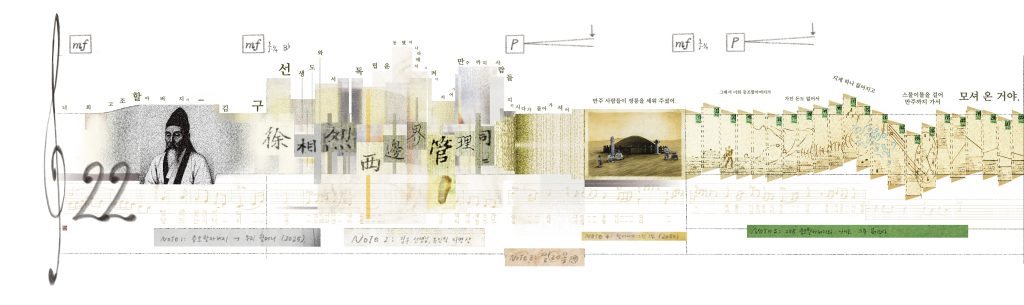
I chose this because it already contains time, voice, and emotion. But even here, these elements are still partially flattened. So this becomes my testing ground. A site where I can examine my own act of translating, observe how flattening occurs, and experiment with how it might be undone.
Therefore, My practice shifts from translating structures to examining how representation itself flattens complexity—and how this flattening can be resisted through iteration.
Iteration Unflattening:
Started to expand all the records, stories and photos needed to create the auditory map.
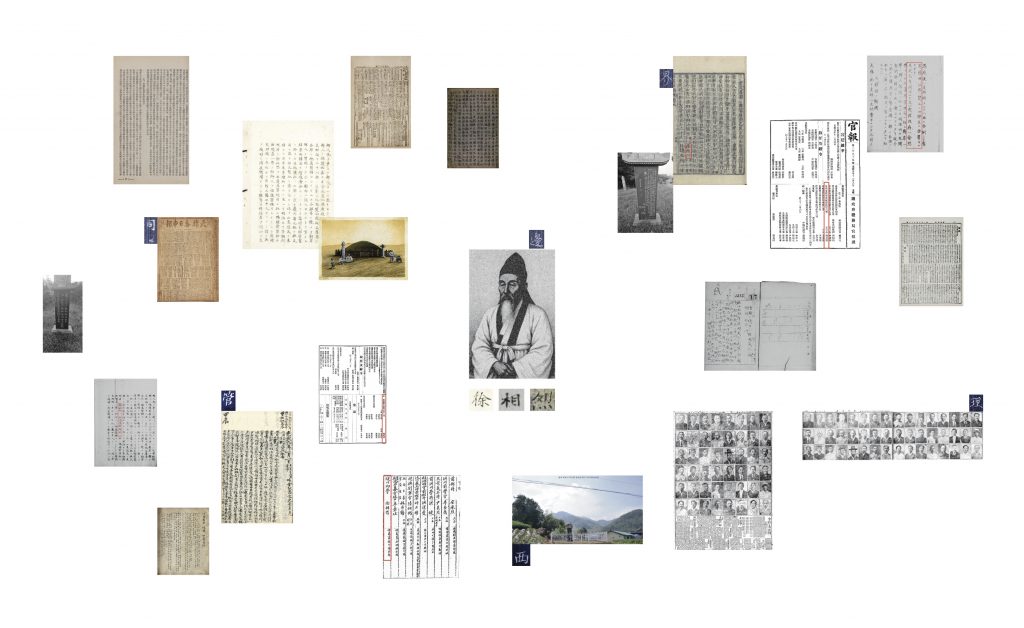
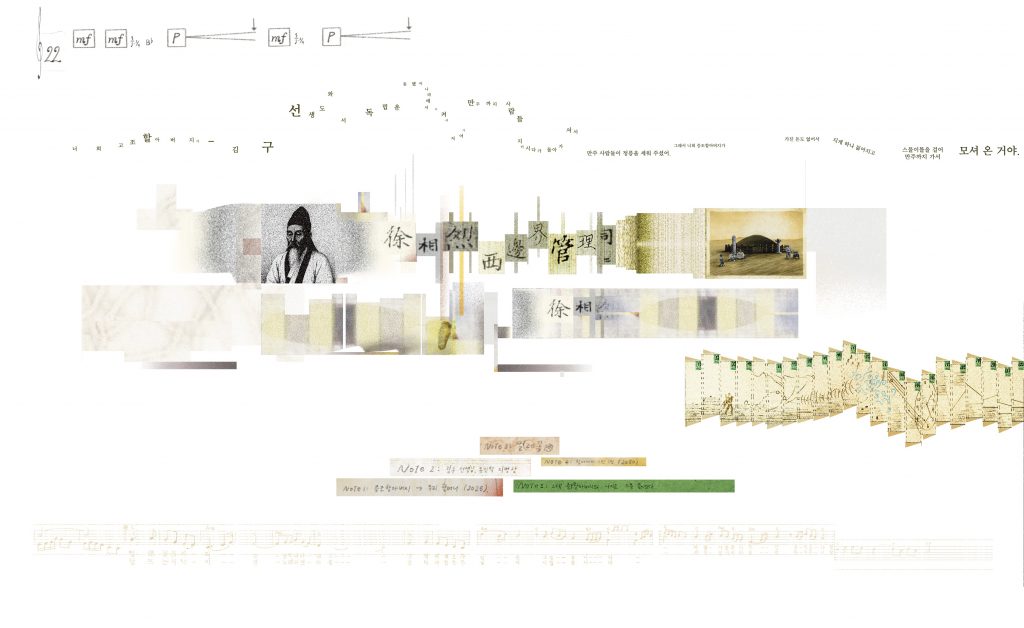
Iteration flattening:
Then, I deliberately push the process of flattening to its extreme.
- Starting from the original materials, I selectively extract certain pieces of information and through this act of selection, the story begins to become a map. As the process continues, the narrative is progressively compressed.
- I layer everything on top of each other, erasing emotional tone so that only cold, factual information remains.
- Events are reduced into icons, where the richness of the story disappears into symbolic form.
- Time is converted into numbers, removing the lived experience of duration and transforming it into data.
- Finally, the entire narrative is condensed into a single sentence— an extreme form of flattening.
This led me to an important realisation: Flattening is not just the result it is already embedded in the process.
As mapping suggests, “mapping begins with selection, and selection is already flattening.” The moment I choose what to include, what to edit, and how to represent something I am already flattening its complexity.
Iteration Unflattening:
Restore time and narrative to what has been flattened.
Through this process, I investigated how experience, emotion, and structure contribute to the formation of a multidimensional story. What begins as a simple experiment evolves into a mode of investigation.
By re-expanding the meanings altered through flattening—examining what was removed, shifted, or newly produced—the work tests whether a flattened narrative can be reconstituted into a layered, spatial, and relational form once again.
While I was experimenting with unflattening, I started to do some research on non-flat story. A non-flat story is not linear, not singular, and not resolved. It accumulates, overlaps, and resists closure.
So I decided to test the further with iterations on Non-linear time and Accumulation.
Leave a Reply